RESEARCH

Detailed Study of the properties of resolved stars in nearby galaxies.
Figure: Sculptor dSph, taken with ESO WFI
Recent papers have concentrated on the properties of carefully selected samples of individual Red Giant Branch stars in nearby dwarf spheroidal galaxies, e.g. Sculptor dSph and Sextans dSph:
A 3D view of dwarf galaxies with Gaia and VLT/FLAMES. I. The Sculptor dwarf spheroidal Tolstoy et al. 2023 A&A, 675, A49
A 3D view of dwarf galaxies with Gaia and VLT/FLAMES. I. The Sculptor dwarf spheroidal Tolstoy et al. 2023 A&A, 675, A49
A 3D view of dwarf galaxies with Gaia and VLT/FLAMES: II. The Sextans dwarf spheroidal. Tolstoy et al. 2025 A&A, 698, A53
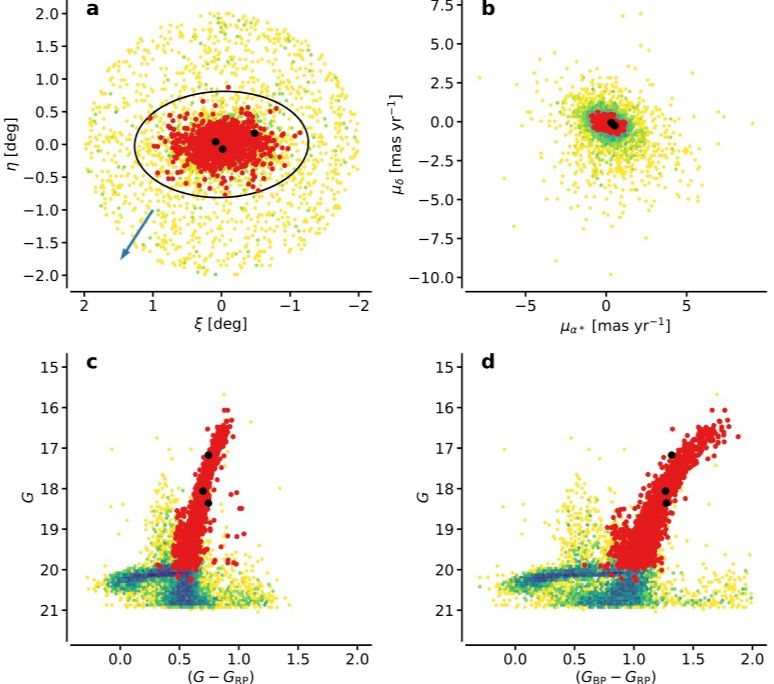
Sculptor dSph members in the VLT/FLAMES sample (red), as well as all Gaia DR3 Sculptor members selected on the basis of parallax and proper motion only (yellow-green colour coding): (a) on the sky, where the black ellipse indicates the nominal tidal radius and the blue arrow the direction of proper motion of Sculptor in the plane of the sky; (b) in proper motion; and (c) and (d) in the CMDs. The larger black symbols indicate the borderline cases between non-members and members.
From Tolstoy et al. 2023
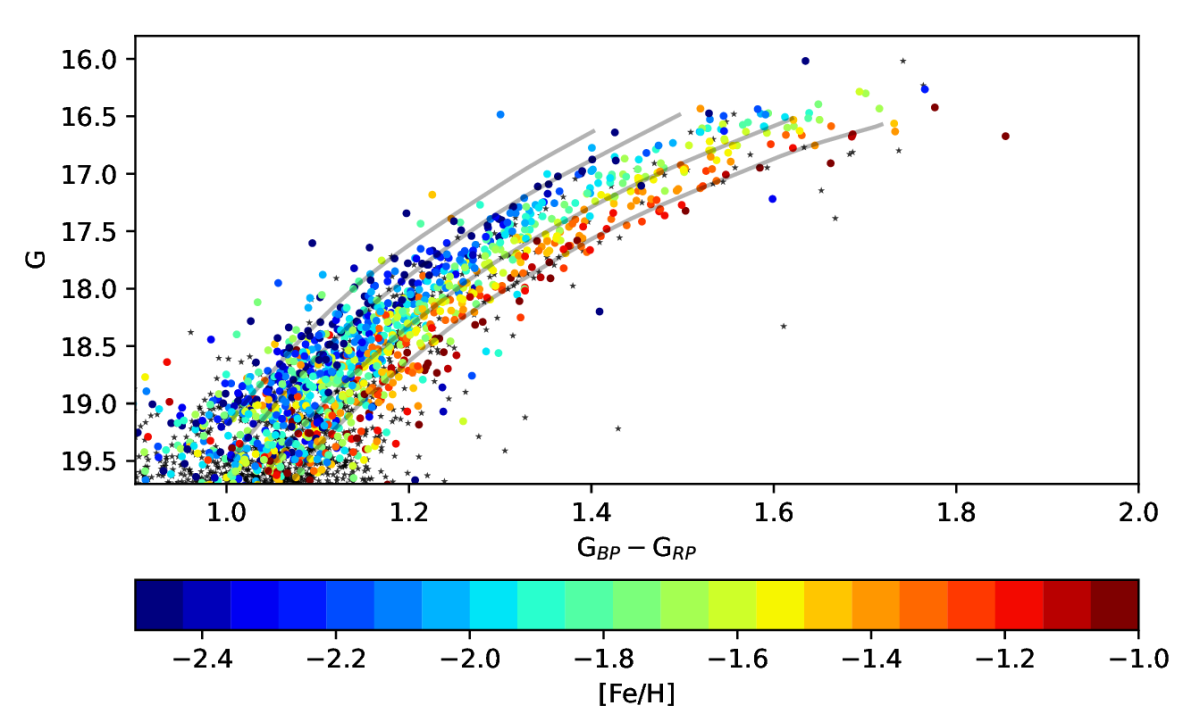
Gaia DR3 CMD for the 1339 (S/N > 13) members of the Sculptor dSph, colour-coded by [Fe/H]. Small black stars are Gaia DR3 members without VLT/FLAMES spectroscopy or insufficiently accurate [Fe/H] measurements. Grey lines are BASTI RGB isochrones, with [α/Fe] = + 0.4, for (from left to right): [Fe/H] = − 3.2, −2.2, −1.7, −1.4; and age = 13, 13, 12, 10 Gyr.
From Tolstoy et al. 2023
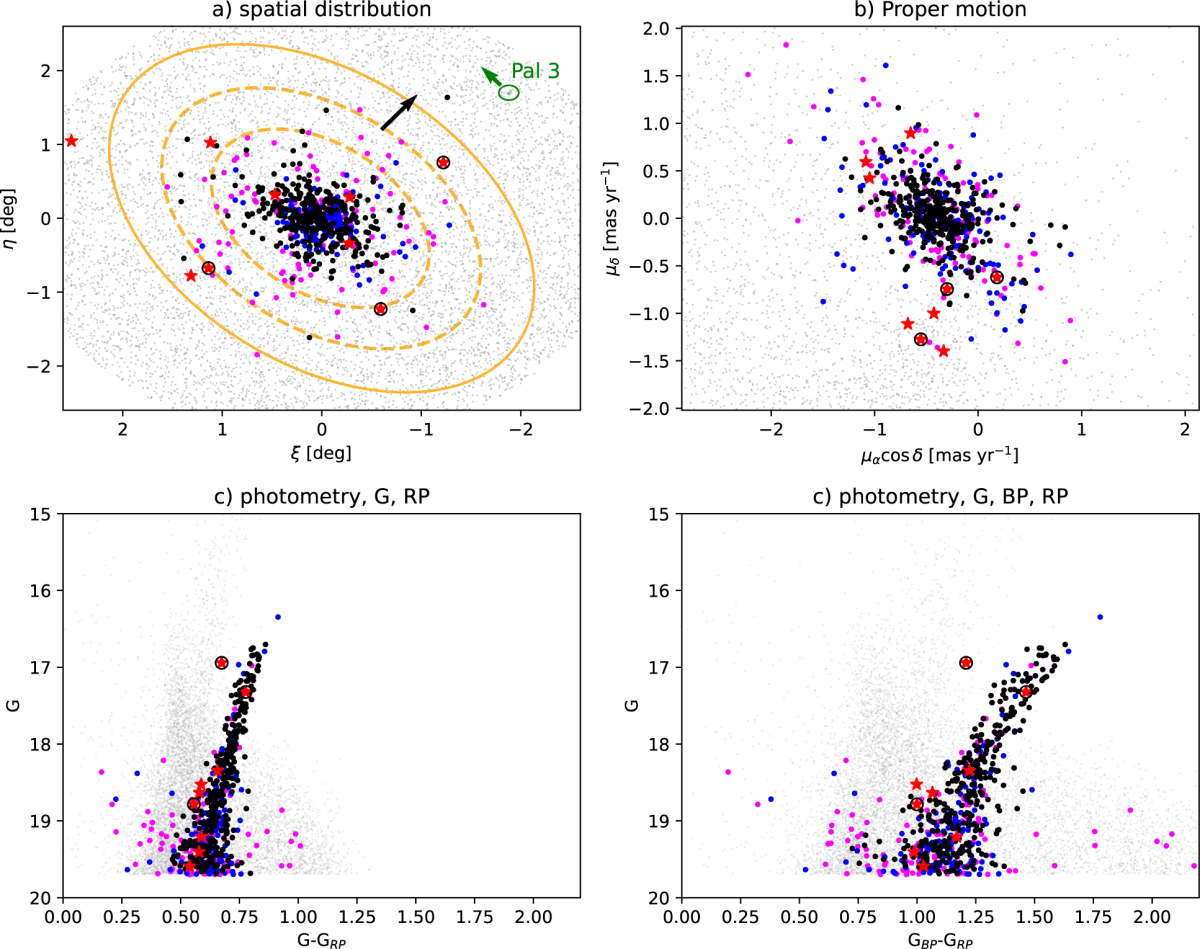
Gaia DR3/FLAMES membership selection for the Sextans dSph: (a) spatial distribution of Gaia DR3 positions overlaid with the spectroscopic members. The largest solid orange ellipse is the nominal tidal radius from Irwin & Hatzidimitriou (1995). The dashed line ellipses are from Cicuéndez et al. (2018) (outer) and Roderick et al. (2016) (inner). The black arrow is the mean proper motion on the sky of Sextans and the green arrow is the same for the Pal 3 globular cluster, which is at the position of the green ellipse; (b) Gaia DR3 proper motions in RA and Dec; (c, d) CMDS from Gaia DR3 photometry. In all plots, grey dots are the Gaia DR3 catalogue entries, for G < 19.7. The magenta dots are the 604 likely members of Sextans. Overplotted as black dots are 333 Gaia/FLAMES members (with S/N > 10 per pixel and G < 19.7) and 146 blue dots from Walker et al. (2023) that are not in the FLAMES catalogue. The nine red stars are in the FLAMES sample with a line-of-sight velocity that is consistent with membership, but just outside the Gaia membership criteria. The three red stars with an additional black circle have lower line-of sight velocity than the rest of the member stars (< 190 km/s), but are within 4σ of the mean systemic line-of sight velocity.
From Tolstoy et al. 2025